
Technology
Fevertree Share Price: What Drives It and How to Track It


Quick Answer
Fevertree Drinks plc trades on the London Stock Exchange under the ticker FEVR (also written FEVR.L). In late July 2026, shares have generally traded in the range of roughly 800p to 820p, though the exact price shifts throughout each trading session. Fevertree is a UK-based premium mixer company best known for its tonic water, ginger ales, and cocktail mixers. For the exact live price, check a financial data provider directly, since most free sites show quotes delayed by around 15 to 20 minutes.
What Is Fevertree Drinks?
Fevertree Drinks, often written as Fever-Tree, is a British beverage company that makes premium carbonated mixers. The company built its name on the idea that better ingredients make better drinks, particularly when paired with spirits like gin and vodka.
Its product range includes premium tonic waters, flavored tonics, ginger ales and ginger beers, colas, lemonades, sodas, and a growing line of cocktail mixers such as margarita and espresso martini mixes. Fevertree sells across the UK, the United States, Europe, and other international markets, and operates through several subsidiaries in the US, Germany, and elsewhere.
Fevertree is listed on the London Stock Exchange and has historically been included in indices covering UK small and mid-cap companies, with its exact index membership shifting somewhat over time as its market value changes.
Where the Share Price Stands and Why It Moves
Fevertree’s share price has swung fairly widely over the past year, trading somewhere between roughly 710p at the low end and just over 1,000p at the high end. That kind of range reflects how sensitive the stock is to shifts in consumer spending patterns and competitive pressure in the mixer and soft drinks category.
Several factors commonly drive movement in Fevertree’s share price:
- Sales volumes in key markets. The US and UK are Fevertree’s largest markets, so quarterly updates on volume growth or decline in these regions tend to move the stock.
- Competition in the mixer category. Fevertree helped create the premium mixer market, but larger beverage companies and private-label competitors have moved into the space, and competitive pressure affects investor sentiment.
- Weather and seasonal demand. Because mixers are often paired with spirits for warm-weather drinking occasions, unusually hot or cold seasons in key markets can noticeably affect short-term sales and, in turn, the share price.
- Share buyback activity. Fevertree has carried out share buyback programs at times, which can support the price by reducing the number of shares outstanding.
- Margin trends. Input costs like glass, sugar, and shipping affect profitability, and changes in these costs show up in the company’s margin performance.
- Broader consumer discretionary sentiment. As a premium, non-essential product, Fevertree’s stock often moves along with wider trends in consumer spending confidence.
How the Share Price Is Quoted
Like other UK-listed companies, Fevertree’s share price is quoted in pence, shown as GBX or simply “p.” A quoted price of “800” means 800 pence, or £8.00 per share. This is worth keeping in mind, since readers used to seeing prices in whole currency units sometimes misread pence-denominated prices as far smaller than they actually are.
Key Facts About Fevertree Stock
- Ticker symbol: FEVR (LSE: FEVR.L)
- Exchange: London Stock Exchange
- Founded: 2004
- Headquarters: United Kingdom
- Main product categories: Tonic water, ginger ales and beers, colas, lemonades, sodas, and cocktail mixers
- Key markets: United Kingdom, United States, Europe, and international markets
- Share price is quoted in: Pence (GBX), not pounds
- 52-week range (as of mid-2026): Roughly 710p to 1,020p
- Shares in issue: Around 112 to 114 million
Common Mistakes When Checking Share Prices
Reading pence as pounds. As noted above, “800” means £8.00, not £800. Misreading this can make the stock look ten times more or less expensive than it really is.
Assuming free quotes update in real time. Most free financial sites show prices delayed by roughly 15 to 20 minutes. For general research, this is fine, but it’s not precise enough for placing an actual trade.
Treating a wide 52-week range as unusual. A range stretching from 710p to over 1,000p might look alarming at first, but this kind of volatility isn’t unusual for a mid-cap consumer stock exposed to shifting demand and competitive pressure. Context matters more than the raw range.
Confusing dividend yield with total return. Fevertree’s dividend yield has generally been modest, sitting in the low single digits as a percentage. Investors focused only on yield may overlook the larger role that share price appreciation or decline plays in total return for this particular stock.
Real-World Example
Imagine an investor tracking Fevertree’s share price through a hot summer versus a cooler, wetter one. Warmer weather in key markets like the UK often coincides with increased demand for mixers paired with spirits, which can lift short-term sales figures and, in some cases, investor sentiment. A cooler or wetter season might see the opposite effect. This is one reason quarterly trading updates from the company often draw specific attention to weather conditions in its commentary.
Frequently Asked Questions
Q1: What is Fevertree’s stock ticker?
Ans: Fevertree trades under the ticker FEVR on the London Stock Exchange, often written as FEVR.L.
Q2: Is the Fevertree share price quoted in pounds or pence?
Ans:Pence. A price shown as “800” means 800 pence, equal to £8.00 per share.
Q3: What does Fevertree Drinks actually make?
Ans:Premium carbonated mixers, including tonic waters, ginger ales and beers, colas, lemonades, sodas, and cocktail mixers, sold primarily to pair with spirits.
Q4: Does Fevertree pay a dividend?
Ans:Yes, though the yield has generally been modest compared to some other UK-listed consumer companies, and has varied year to year based on company performance and payout decisions.
Q5: Where can I find the live Fevertree share price?
Ans: Live or near-live prices are available directly through the London Stock Exchange, major financial data platforms, or a stockbroker’s trading account. Free sites typically show a short delay.
Q6: Is Fevertree a risky stock to hold?
Ans: Like any individual stock, Fevertree carries company-specific risk. Its exposure to a competitive premium mixer category, its reliance on discretionary consumer spending, and its sensitivity to input costs are all factors that have contributed to notable share price swings in recent years.
Key Takeaways
- Fevertree Drinks (ticker: FEVR) is a UK-based premium mixer company listed on the London Stock Exchange.
- The stock is quoted in pence, not pounds, so “800” means £8.00 per share.
- Sales volumes, competitive pressure, weather patterns, and margin trends are among the biggest drivers of the share price.
- The stock has shown a wide trading range over the past year, which is common for mid-cap consumer companies facing shifting demand.
- For an exact, current price, use a live financial data source rather than a static article, since quotes change constantly during trading hours.
A Final Note
This article explains how Fevertree’s share price works and what tends to move it, but the specific numbers mentioned here are a snapshot that will age quickly. It isn’t financial advice. Anyone considering buying or selling shares should check live pricing data and consider speaking with a qualified financial advisor first.
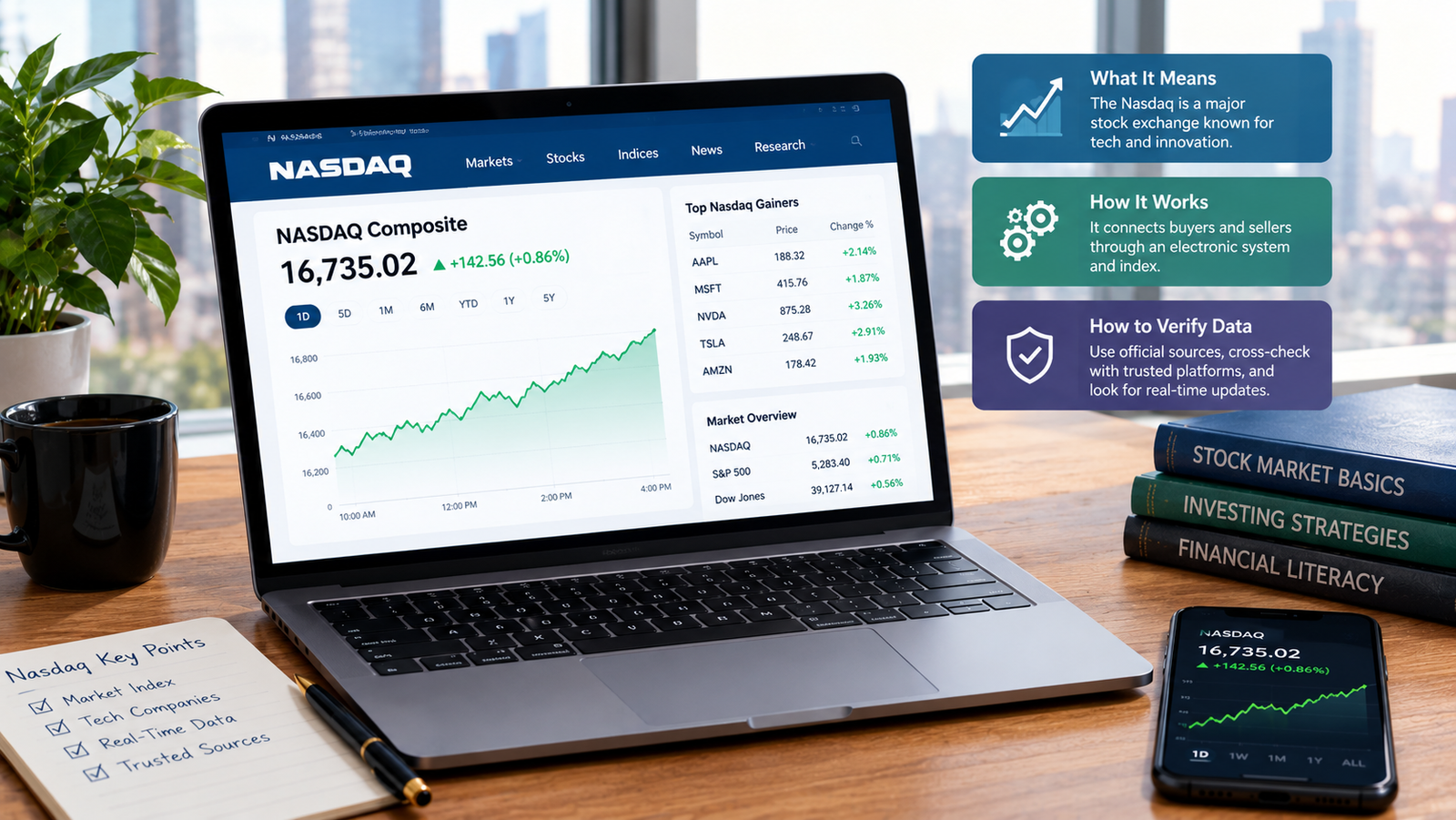
Introduction
Searches for fintechzoom.io nasdaq can be confusing because the phrase sounds like the name of an official Nasdaq service. It is not.
FintechZoom.io is a financial information website that publishes articles and market commentary covering stocks, cryptocurrencies, financial technology, and major market indexes. Its Nasdaq-focused content discusses the Nasdaq Composite and related market trends. The Nasdaq Stock Market, however, is a separate financial-market institution that operates exchanges, publishes indexes, and provides market data and technology services.
This distinction matters when researching stock prices, index levels, forecasts, or investment ideas. FintechZoom can be useful as a secondary source for commentary, but official Nasdaq pages are the better reference for confirming index definitions, methodology, components, and official market information.
Direct Answer: What Is FintechZoom.io Nasdaq?
FintechZoom.io Nasdaq refers to FintechZoom.io’s coverage and analysis of Nasdaq markets, especially the Nasdaq Composite Index. It is not a separate Nasdaq exchange, official Nasdaq index, or Nasdaq-owned investment platform. FintechZoom publishes market commentary, charts, stock analysis, and articles about Nasdaq-related topics, while Nasdaq itself maintains the official exchange and index infrastructure. Investors should verify important prices, index data, methodology, and corporate information through Nasdaq or other authoritative financial sources.
What Is FintechZoom.io?
FintechZoom.io describes itself as a financial technology and market-information website. Its homepage says it covers financial technology, stocks, cryptocurrencies, and global indexes, with specific attention to markets such as Nasdaq and the Dow Jones. It also publishes stock-focused articles and other financial content.
The website’s Nasdaq article is titled “Nasdaq FintechZoom – Navigating The Past, Present & Future Charts.” It presents FintechZoom as a resource for following the Nasdaq Composite, including market charts, technical analysis, news, and commentary.
That means the phrase FintechZoom.io Nasdaq is best understood as a search term describing a relationship between:
- FintechZoom.io
- Nasdaq market coverage
- Nasdaq indexes
- Stock-market analysis
- Financial news and commentary
It should not be interpreted as the official name of a Nasdaq product.
What Is Nasdaq?
Nasdaq can refer to both a major U.S. stock exchange and the broader Nasdaq organization.
The Nasdaq Stock Market is a major U.S. equities exchange. Nasdaq describes it as the largest U.S. equities exchange venue by market share and says it provides liquidity, price discovery, trading infrastructure, and market services.
Nasdaq is also the name of the publicly traded company Nasdaq, Inc., whose stock trades under the ticker NDAQ on the Nasdaq Global Select Market.
This creates an important distinction:
Nasdaq Stock Market
This is the exchange where securities are listed and traded.
Nasdaq, Inc.
This is the publicly traded company that operates businesses involving exchanges, market infrastructure, financial technology, data, analytics, listings, and related services.
Nasdaq Indexes
These are benchmarks designed to measure particular groups of securities.
Examples include:
- Nasdaq Composite
- Nasdaq-100
- Nasdaq-100 Equal Weighted Index
- Other Nasdaq indexes
Therefore, saying “Nasdaq is up” without identifying the specific index can sometimes be ambiguous.
FintechZoom.io Nasdaq vs. Official Nasdaq
The most important distinction for readers is simple:
| Feature | FintechZoom.io | Nasdaq |
| What it is | Financial information website | Financial-market organization and exchange operator |
| Nasdaq coverage | Articles, commentary, charts and analysis | Official market and index infrastructure |
| Official exchange | No | Yes |
| Official Nasdaq index publisher | No | Yes |
| Market commentary | Yes | Yes, through official research and newsroom content |
| Index methodology | May discuss it | Official source |
| Investment research | Publishes financial content | Provides extensive market and company information |
| Primary authority for Nasdaq index rules | No | Yes |
FintechZoom’s own article describes its Nasdaq coverage as a way to track and analyze the Nasdaq Composite. Nasdaq, meanwhile, publishes the official definition and methodology of the indexes themselves.
That difference is particularly important when an article gives a specific numerical claim.
What Is the Nasdaq Composite?
The Nasdaq Composite Index, ticker COMP, is one of the most widely followed Nasdaq indexes.
According to Nasdaq’s official index description, the Composite measures domestic and international common-type stocks listed on the Nasdaq Stock Market. Nasdaq currently describes it as a broad-based index containing more than 2,500 companies.
The current methodology provides additional detail. Eligible securities generally include common stocks, ordinary shares, American Depositary Receipts (ADRs), limited partnership interests, and certain other eligible equity structures. The security must be listed on the Nasdaq Stock Exchange under the methodology’s requirements.
This broad composition is one reason the Nasdaq Composite is different from the Nasdaq-100.
Nasdaq Composite vs. Nasdaq-100
This is one of the most common sources of confusion in searches involving FintechZoom.io Nasdaq.
The two indexes share the Nasdaq name, but they are not the same benchmark.
Nasdaq Composite
The Nasdaq Composite covers a much broader group of companies listed on the Nasdaq Stock Market. Nasdaq currently reports thousands of components for the index.
Nasdaq-100
The Nasdaq-100 is a narrower index with a different eligibility and construction methodology.
It is widely used as a benchmark for large non-financial companies listed on Nasdaq and is closely associated with technology and growth-oriented businesses.
Nasdaq itself recently emphasized that the Composite and Nasdaq-100 have different construction rules and should not be treated as interchangeable.
Why the Difference Matters
Suppose someone searches “Nasdaq today” and sees a number on a financial website.
That number may refer to the Nasdaq Composite, while another article may discuss the Nasdaq-100.
Both can move in different ways.
A reader should therefore ask:
Which Nasdaq index is being discussed?
That single question prevents many market-data mistakes.
What Does FintechZoom Say About Nasdaq?
FintechZoom’s dedicated Nasdaq article presents the site as a source for following the Nasdaq Composite through charts, technical indicators, news, and market commentary. It also discusses Nasdaq’s electronic trading history, market tiers, technology companies, and broader financial-market trends.
The article describes features such as:
- Performance charts
- Technical indicators
- Market news
- Historical information
- Stock analysis
- Commentary
- Educational material
These are useful categories for understanding how an investor might research a market.
However, there is an important limitation: FintechZoom’s descriptions should not be confused with official Nasdaq definitions or guarantees of real-time data quality.
For example, its article uses phrases such as “real-time tracking” and makes broad claims about market-analysis capabilities.
When exact market data matters, the source and timestamp should be checked.
How to Verify FintechZoom.io Nasdaq Data
A practical approach is to treat financial websites in two categories:
Secondary information: commentary, explanations, opinions, market summaries and analysis.
Primary information: official exchange data, index methodology, regulatory filings and company disclosures.
FintechZoom can fall into the first category.
Nasdaq’s official index pages are the stronger source for confirming the second category.
Step 1: Identify the Index
Determine whether the article refers to:
- Nasdaq Composite
- Nasdaq-100
- Another Nasdaq index
- An individual Nasdaq-listed company
- Nasdaq, Inc. stock (NDAQ)
Do not assume they are interchangeable.
Step 2: Check the Ticker
For the Nasdaq Composite, the official Nasdaq index page identifies the ticker as COMP.
For Nasdaq, Inc., the company’s stock ticker is NDAQ.
Those are completely different things.
Step 3: Check the Date
Market information becomes outdated quickly.
An index value from yesterday should not be presented as today’s value. Historical forecasts also need their original publication date.
Step 4: Compare With Nasdaq
Nasdaq maintains official index pages and market-data resources. Its Nasdaq Composite page provides the index level, historical performance options, methodology information, and related details.
Step 5: Check the Methodology
If an article makes a claim about which securities belong in an index, check the official methodology rather than relying only on a blog post.
Nasdaq’s Composite methodology explains eligible security types, listing requirements, geography rules, and other construction criteria.
Why Current Data Matters
One of the clearest reasons to verify old FintechZoom material is that market conditions change.
FintechZoom’s dedicated Nasdaq article contains a forecast table that projected Nasdaq points for future years, including a 17,500-point figure for 2026.
That forecast should not be treated as a current market target.
Nasdaq’s official Composite data for October 5, 2026, showed a closing level of 27,477.31.
The comparison illustrates a broader lesson:
A historical forecast is not the same thing as current market data.
Forecasts can be useful for understanding what an analyst expected at a particular time. They should never be presented as if they were current facts.
This is particularly important when older articles continue appearing in search results.
What Information Can FintechZoom Provide About Nasdaq?
FintechZoom’s Nasdaq coverage can help readers explore several types of information.
Market Commentary
Articles may discuss market movements and possible factors affecting stocks.
Commentary can provide context, but it represents analysis rather than guaranteed outcomes.
Technical Analysis
Technical analysis generally examines price behavior, volume, trends, support and resistance levels, momentum indicators, and other market data.
These tools can help traders organize information, but they do not guarantee future prices.
Charts
Charts allow readers to see how an index or security moved over a selected period.
A one-day chart answers a different question from a five-year chart.
News
Market news can help explain why a stock or index moved.
For example, earnings announcements, interest-rate expectations, economic reports, regulatory developments, and major corporate events can influence market prices.
Stock Research
FintechZoom also publishes articles about individual stocks and other financial assets. Its stock section includes topics covering companies, indexes, commodities, and broader financial markets.
How Nasdaq Data Should Be Interpreted
Seeing an index rise does not automatically mean every stock listed on Nasdaq is rising.
The Nasdaq Composite is an index representing a broad collection of securities. Individual companies can move in the opposite direction.
For example:
- The Composite could rise while one technology stock falls.
- The Nasdaq-100 could outperform the Composite.
- Small-cap Nasdaq-listed companies could decline while large technology companies rise.
- A strong index day could hide weakness in many individual securities.
This is why investors should avoid using one index number as a complete description of the market.
Why Technology Stocks Matter to Nasdaq
Nasdaq is strongly associated with technology companies, although it is incorrect to say that Nasdaq consists only of technology stocks.
Its listed companies span multiple sectors.
The exchange’s own materials describe Nasdaq as a marketplace containing companies across areas including technology and other industries.
Technology companies can nevertheless have a major influence on how people perceive Nasdaq because several large and widely followed technology businesses trade on Nasdaq.
This creates an important psychological effect: major technology-stock movements can strongly affect public discussion about “the Nasdaq.”
Is FintechZoom.io Nasdaq an Investment Platform?
No, the phrase should not be interpreted as the name of a separate investment exchange or brokerage.
FintechZoom.io publishes financial information and analysis. Its Nasdaq article discusses market tracking and analysis, but that does not make FintechZoom the Nasdaq exchange or a substitute for a regulated broker.
Actual securities transactions generally take place through a broker or another appropriately regulated market-access provider.
Nasdaq itself explains that shares of Nasdaq, Inc. can be bought or sold through a registered broker.
This distinction is especially important for readers who encounter websites that use familiar financial terms.
Reading market information and executing a trade are two different activities.
Is FintechZoom.io Nasdaq Safe to Use?
There are two separate questions here.
Is the website the Nasdaq exchange?
No. FintechZoom.io and Nasdaq are separate entities.
Can its articles be used for financial research?
They can be read as secondary financial commentary, but important information should be independently verified.
For financial decisions, readers should confirm:
- current prices
- index values
- company filings
- earnings information
- index methodology
- corporate actions
- regulatory information
through authoritative sources.
The reason is simple: financial information can become outdated, and analysis is not the same as verified market data.
Common Mistakes When Searching FintechZoom.io Nasdaq
Mistake 1: Assuming FintechZoom Owns Nasdaq
It does not.
FintechZoom.io is a separate financial information website.
Mistake 2: Treating “Nasdaq” as One Index
Nasdaq refers to an exchange and organization, while several different indexes use the Nasdaq name.
The Composite and Nasdaq-100 have different rules.
Mistake 3: Treating an Old Forecast as a Current Prediction
A forecast published years ago represents an expectation at that time.
It should not be copied into a current article without clearly labeling it as historical.
Mistake 4: Assuming Every Nasdaq Company Is a Technology Company
Nasdaq lists companies across multiple industries.
Technology is prominent, but the exchange is not limited to technology businesses.
Mistake 5: Using One Website as the Only Source
Market research is stronger when information is cross-checked.
A financial article may provide context, while an exchange, regulator, or company filing provides the authoritative underlying information.
Real-World Example: How a Reader Should Research Nasdaq
Imagine a reader sees a FintechZoom article saying that Nasdaq is rising.
Instead of immediately concluding that every technology stock is performing well, the reader could follow this process:
First, identify whether the article means the Nasdaq Composite or Nasdaq-100.
Second, check the date and time of the quoted data.
Third, compare the number with Nasdaq’s official index page.
Fourth, look at the major market-moving news for that session.
Fifth, if the reader is researching a particular company, examine that company’s own filings and financial results rather than assuming its stock follows the index.
This approach produces a much more reliable picture of market conditions.
FintechZoom.io Nasdaq and Technical Analysis
Technical analysis is another major topic associated with FintechZoom’s Nasdaq coverage.
Technical indicators can include:
- Moving averages
- Relative Strength Index (RSI)
- Moving Average Convergence Divergence (MACD)
- Trading volume
- Support and resistance
- Price trends
- Volatility measures
These indicators are tools for interpreting market behavior.
They are not predictions with guaranteed outcomes.
For example, if a stock trades above a moving average, that may be interpreted as a sign of strength by some traders. But a market can reverse unexpectedly because of earnings, economic data, geopolitical developments, or other events.
Technical analysis therefore works best as one component of research rather than as a certainty machine.
Limitations of FintechZoom.io Nasdaq Coverage
Readers should understand several limitations.
Data-source transparency
A third-party website may display market data without making the underlying feed or timing obvious to every reader.
When timing matters, confirm the information with an authoritative source.
Historical content
Financial websites can retain articles for years.
An old article can remain accessible even after its assumptions or forecasts have become outdated.
Forecast uncertainty
Predictions are inherently uncertain.
Even professional market analysts can be wrong because markets respond to information that cannot always be anticipated.
Editorial interpretation
Commentary represents an interpretation of market events.
Two analysts can examine the same chart and reach different conclusions.
Terminology
Search phrases such as “Nasdaq FintechZoom” can blur the distinction between a website discussing an index and the organization that operates the exchange.
Key Facts About FintechZoom.io Nasdaq
- FintechZoom.io is a financial information website, not the Nasdaq exchange.
- FintechZoom publishes Nasdaq-related articles covering market movements, charts, technical analysis, and commentary.
- The Nasdaq Stock Market is a major U.S. equities exchange.
- The Nasdaq Composite is an official Nasdaq index covering domestic and international common-type stocks listed on the Nasdaq Stock Market.
- The Nasdaq Composite and Nasdaq-100 are different indexes with different construction rules.
- Nasdaq’s official Composite ticker is COMP.
- Nasdaq, Inc.’s stock ticker is NDAQ, which is different from the Nasdaq Composite.
- Historical forecasts published by financial websites should not be treated as current market data.
- Nasdaq’s official index pages are the appropriate place to verify index methodology and current official index information.
Frequently Asked Questions
What does FintechZoom.io Nasdaq mean?
FintechZoom.io Nasdaq generally refers to FintechZoom.io’s coverage of Nasdaq markets, especially the Nasdaq Composite. It is not the name of a separate Nasdaq exchange, official index, or Nasdaq-owned platform.
Is FintechZoom affiliated with Nasdaq?
The available information does not establish FintechZoom.io as an official Nasdaq exchange or Nasdaq-owned product. FintechZoom publishes independent Nasdaq-related content, while Nasdaq maintains its own official market and index resources.
Is Nasdaq the same as the Nasdaq Composite?
No. Nasdaq can refer to the Nasdaq Stock Market and the broader Nasdaq organization, while the Nasdaq Composite is a specific index measuring eligible securities listed on the Nasdaq Stock Market.
What is the Nasdaq Composite ticker?
The official Nasdaq Composite ticker is COMP. Nasdaq’s index page identifies it as the Nasdaq Composite Index.
What is NDAQ?
NDAQ is the stock ticker for Nasdaq, Inc., the publicly traded company. It is not the ticker for the Nasdaq Composite Index.
Is the Nasdaq Composite the same as the Nasdaq-100?
No. The two indexes have different eligibility requirements and construction methodologies. The Nasdaq-100 is narrower, while the Nasdaq Composite covers a much broader group of Nasdaq-listed securities.
Can FintechZoom be used for stock research?
It can be used as a source of financial commentary and market information. However, important market facts should be cross-checked against official exchange, company, or regulatory sources.
Does FintechZoom provide investment advice?
FintechZoom publishes financial analysis and commentary, but readers should distinguish general market commentary from personalized financial advice. A market article cannot determine whether an investment is suitable for a particular person’s financial situation.
How accurate are FintechZoom Nasdaq forecasts?
Forecast accuracy varies. A forecast should be judged by its publication date, methodology, assumptions, and subsequent market results. It should never be treated as a guaranteed future price.
Where can I verify Nasdaq Composite data?
Nasdaq’s official index pages provide the Composite’s official index information, including its definition, current index data, methodology, and related resources.
Why does FintechZoom call its coverage “Nasdaq FintechZoom”?
That phrase appears to be FintechZoom’s way of describing its Nasdaq-focused financial content. It should not be interpreted as evidence that “Nasdaq FintechZoom” is an official Nasdaq product.
Is FintechZoom the Nasdaq trading platform?
No. FintechZoom.io is a financial information website. The Nasdaq Stock Market is the actual exchange venue. These are separate entities.
Key Takeaways
- FintechZoom.io Nasdaq is primarily a search phrase for FintechZoom’s Nasdaq-related coverage.
- FintechZoom.io is not the Nasdaq Stock Market.
- The Nasdaq Stock Market is an actual U.S. equities exchange and part of the broader Nasdaq organization.
- The Nasdaq Composite is a separate index identified by COMP.
- The Nasdaq-100 is a different index with different eligibility and construction rules.
- NDAQ refers to the publicly traded stock of Nasdaq, Inc., not the Nasdaq Composite.
- FintechZoom’s Nasdaq content can provide commentary, charts, and analysis, but official Nasdaq resources should be used to verify important market information.
- Historical forecasts should always be labeled as historical.
- Market commentary should not be confused with guaranteed investment predictions.
- Checking the index name, ticker, date, and primary source can prevent most Nasdaq-related research errors.
Conclusion
The phrase fintechzoom.io nasdaq can initially sound like a single financial platform, but it actually combines two separate entities: FintechZoom.io, a financial information website, and Nasdaq, the major exchange and financial-market organization.
FintechZoom’s Nasdaq-focused content discusses the Nasdaq Composite, market trends, technical analysis, stock movements, and financial developments. That makes it potentially useful as secondary reading. However, it does not replace Nasdaq’s official resources when the goal is to verify an index definition, methodology, component rules, or current market information.
The most useful habit for anyone researching Nasdaq is to identify exactly what is being discussed. The Nasdaq Composite, Nasdaq-100, Nasdaq Stock Market, and Nasdaq, Inc. are related but distinct concepts.
For current or investment-sensitive information, verify the underlying data through authoritative sources and treat forecasts as estimates rather than facts. This distinction makes financial research more accurate and helps readers avoid one of the most common problems with online market content: confusing commentary about a market with the market itself.

Why People Search for This Every Year
Twice a year, millions of people across the United States ask themselves the same question: do I move the clock forward or back, and on exactly what day? The confusion is understandable, since the date shifts slightly from year to year, and not every state follows the same rule. On top of that, plenty of people search for this right before a work shift, a flight, or an appointment, wanting to confirm the exact date so nothing gets missed.
This guide breaks down exactly when the time changes in the USA, how the system works, which states and territories skip it, and how to avoid getting caught off guard.
Direct Answer
In the United States, daylight saving time begins on the second Sunday of March, when clocks move forward one hour, and ends on the first Sunday of November, when clocks move back one hour. In 2026, the spring change happened on Sunday, March 8, and the fall change will happen on Sunday, November 1. Hawaii and most of Arizona do not participate in this change.
How the Time Change Works in the United States
The system is based on daylight saving time (DST), designed to make better use of natural daylight during the warmer months. Clocks move forward in spring so it stays light later into the evening, then return to standard time in fall.
The change technically happens at 2:00 a.m. In March, that moment jumps straight to 3:00 a.m., so an hour of sleep is lost. In November, the opposite happens: at 2:00 a.m., clocks fall back to 1:00 a.m., giving an extra hour.
Most electronic devices, like smartphones and computers, adjust automatically. Wall clocks, ovens, and other devices without an internet connection need to be changed manually.
2026 Time Change Dates
- Daylight saving time begins: Sunday, March 8, 2026, at 2:00 a.m. (clocks move forward one hour)
- Daylight saving time ends: Sunday, November 1, 2026, at 2:00 a.m. (clocks move back one hour)
These dates follow the rule set by the Energy Policy Act of 2005, which fixes the spring change for the second Sunday of March and the fall change for the first Sunday of November across most of the country, with a few exceptions.
States and Territories That Don’t Change the Clock
Not all of the United States observes daylight saving time. The following places keep the same time year-round:
- Hawaii – Stays on standard time all year.
- Most of Arizona – The state stopped observing daylight saving time back in 1968, though the Navajo Nation, located in the northeastern part of the state, does participate in the change.
- Puerto Rico – Does not observe daylight saving time.
- U.S. Virgin Islands – Also skips the change.
- Guam – Stays on standard time year-round.
- American Samoa – Does not change the clock.
- Northern Mariana Islands – Also does not observe daylight saving time.
For residents in these areas, the time difference with the rest of the country shifts depending on the season, even though their own clock stays fixed.
Why the Time Change Exists
The idea of adjusting clocks to make better use of daylight isn’t new. While the concept is sometimes credited to Benjamin Franklin, who mentioned it in an 1784 letter, the current March-to-November system used in the U.S. started in 2007.
The main argument in favor of the change is energy savings, by reducing the need for artificial lighting during longer evenings in the warmer months. That said, whether it actually delivers meaningful energy savings remains debated among researchers.
The Debate Over Ending the Time Change
In recent years, the push to eliminate the twice-yearly time change and keep a fixed schedule year-round has gained traction. In 2022, the U.S. Senate passed a bill to make daylight saving time permanent, but the measure never advanced in the House of Representatives, so the current system of two annual changes remains in place.
This debate isn’t unique to the United States. Countries like Mexico eliminated daylight saving time across most of the country in 2022, though Baja California and border municipalities in Chihuahua, Coahuila, Nuevo León, and Tamaulipas still follow the same schedule as the U.S. due to close commercial and social ties with American border regions.
Common Mistakes People Make
Mistake 1: Assuming the whole country changes the clock at the same time. Hawaii, most of Arizona, and several U.S. territories don’t participate in the change, so their time difference with the rest of the country shifts depending on the season.
Mistake 2: Mixing up the direction of the change. Clocks move forward in March (losing an hour) and back in November (gaining an hour). It’s easy to confuse which one applies to which season.
Mistake 3: Assuming the change is already permanent. Even though ending the time change has been debated, no federal law eliminating it entirely has been passed so far.
Mistake 4: Forgetting devices without automatic updates. Many devices like ovens, wall clocks, or car systems without automatic updates need manual adjustment, and forgetting this can lead to scheduling mix-ups.
Real-World Example
Picture a family in Texas with a video call scheduled with relatives in Puerto Rico the same weekend as the March time change. Since Texas moves its clock forward but Puerto Rico doesn’t participate in the change, the time difference between the two locations shifts from one hour to two hours that weekend. Without checking this ahead of time, it’s easy to miscalculate the call time.
Key Facts
- Daylight saving time in the U.S. begins on the second Sunday of March and ends on the first Sunday of November.
- In 2026, the spring change happened on March 8, and the fall change will happen on November 1.
- Hawaii, most of Arizona, Puerto Rico, Guam, the U.S. Virgin Islands, American Samoa, and the Northern Mariana Islands do not participate in the change.
- The change technically takes place at 2:00 a.m. on both dates.
- The current schedule was established by the Energy Policy Act of 2005.
- Proposals to eliminate the time change exist, but none have been passed at the federal level.
Frequently Asked Questions
When does the time change in the United States in 2026?
Daylight saving time began on Sunday, March 8, 2026, and will end on Sunday, November 1, 2026.
Do clocks move forward or back in March?
Clocks move forward one hour in March, marking the start of daylight saving time.
Which states don’t change the clock in the United States?
Hawaii and most of Arizona don’t participate in the time change, along with territories like Puerto Rico, Guam, the U.S. Virgin Islands, American Samoa, and the Northern Mariana Islands.
Why does the time change exist?
The main goal is to make better use of natural daylight during warmer months, reducing the need for artificial lighting in the evenings.
Is it true they’re going to eliminate the time change?
It’s been debated multiple times, including a bill passed by the Senate in 2022, but no federal law has been passed to eliminate it entirely.
Do phones adjust the time automatically?
Yes, most smartphones and computers adjust automatically, though wall clocks and other devices without an internet connection need to be changed manually.
Key Takeaways
- The time change in the United States happens on the second Sunday of March and the first Sunday of November.
- In 2026, the exact dates are March 8 and November 1.
- Not every state and territory participates, which can shift the time difference with other regions depending on the season.
- The debate over eliminating the time change remains active, but no federal law has been passed on the matter.
- Confirming the exact date each year helps avoid mix-ups with appointments, flights, and work schedules.
Summary
Knowing when the Time Change in the USA helps avoid confusion every spring and fall, especially for anyone coordinating across time zones or with states that skip the change, like Hawaii or Arizona. While the debate over a permanent fixed schedule remains unresolved at the federal level, the current system of two annual changes stays in place across most of the country.

If you’ve ever watched a K-drama, you’ve probably noticed that Korean characters don’t all call their fathers the same thing. Sometimes it’s a warm, quick word. Other times it sounds more formal and deliberate. That’s not a scripting choice — it’s just how Korean works.
Korean has multiple words for father, and which one you use says a lot about the situation you’re in. Learning the difference isn’t complicated once you see the logic behind it. And if you’re studying Korean, dating someone Korean, or simply curious after binge-watching a show, this is genuinely useful stuff to know.
Quick Answer
The two main words for dad in Korean are appa (아빠) and abeoji (아버지). Appa is the casual, affectionate word — the equivalent of “dad” or “daddy” in everyday English. Abeoji is the formal version, used in polite or respectful situations, similar to saying “father” in English. Which one you use depends entirely on context and who you are speaking to.
The Two Main Words for Dad in Korean
Appa — Warm, Casual, Everyday
Appa is the word most Koreans use at home. Children say it, but so do adults — it never really gets outgrown the way “daddy” sometimes does in English. It carries warmth and familiarity, and it sounds exactly as natural as yelling “Dad!” across the house.
You hear appa constantly in Korean homes, in K-dramas, and in casual conversation. The emotional tone is the same as the English word “dad.”
When to use appa:
- Speaking directly to your own father in a relaxed setting
- Talking about your dad to friends
- Any informal, family-style conversation
Abeoji — Formal and Respectful
Abeoji is the more formal word. Think of it as the difference between calling someone “Dad” versus “Father” in English. Same person, different register.
You would use abeoji in a speech, when introducing your father to someone important, or when speaking to elders about your family. It sounds more deliberate and carries a tone of respect.
When to use abeoji:
- Formal conversations or written Korean
- Talking about your father to someone older or in a professional setting
- Situations where casual language would feel out of place
Other Korean Words Related to Father
Abeonim — The Honorific Form
Abeonim (아버님) is a step above abeoji in terms of politeness. It is the word you would use when referring to someone else’s father respectfully, or when speaking to your father-in-law directly.
If your Korean friend mentions their dad, referring to him as abeonim shows you are being thoughtful and respectful about their family. It is also the standard word for a father-in-law in most situations.
Buchin — Formal Written Term
Buchin (부친) is a Sino-Korean word for father that comes from Chinese characters. You will not hear it much in everyday conversation, but you might see it in a newspaper article, formal document, or official writing.
It is worth recognizing if you read Korean news or literature, but you do not need it for daily speech.
Why Korean Has Multiple Words for the Same Person
Korean has a built-in system of formality levels. The language adjusts vocabulary, verb endings, and expressions based on the relationship between speakers and the social setting. This applies to family words too.
Appa and abeoji are not two different people — they are two different ways of talking about the same person depending on who you are speaking to and how formal the moment is. A Korean person will switch between these naturally without even thinking about it, the same way English speakers shift between casual and professional language without consciously deciding to.
This matters if you are learning Korean. Using appa in a formal situation can come across as too casual or even disrespectful. Using abeoji at home with your own family sounds stiff and emotionally distant. Getting the right word for the right moment is part of speaking Korean naturally.
The “Our Dad” Habit — Uri Appa
Something that surprises many Korean learners is that Koreans often say uri appa rather than nae appa when talking about their own father.
Uri means “our.” Nae means “my.” So technically, Koreans say “our dad” instead of “my dad.”
This is not a mistake. It reflects a cultural tendency in Korean to think of family and close relationships as shared rather than individually owned. The same pattern shows up with other words — Koreans say “our mom,” “our country,” and even “our house” when referring to their own personal things.
Using “my dad” is not wrong, but “our dad” sounds more natural and is far more common in everyday Korean speech.
Using the Right Word in Different Situations
Here is how this plays out in real life:
At home, talking to your father directly:
Appa is the natural choice. Most Korean adults still call their father appa in relaxed family settings. It is affectionate and completely normal at any age.
Talking about your dad with close friends:
Appa still works fine here. You might say something like “my dad cooks really well” using appa casually.
Talking about your dad to someone older or in a formal setting:
Switch to abeoji. Showing that awareness signals good manners and social intelligence in Korean culture.
Referring to someone else’s father:
Use abeonim. It shows respect for the other person’s family.
Meeting or addressing your father-in-law:
Abeonim is the standard and safest choice. It is respectful without being overly stiff.
Pronunciation Notes
Korean has its own alphabet called Hangul, which is phonetically consistent once you learn it. The romanizations used here (appa, abeoji, abeonim) give a rough idea of how the words sound, but they are not perfect.
One important note: the “pp” in appa represents a tense consonant in Korean. It sounds sharper and more clipped than a regular English “p.” If you say it with a soft English “p,” it can sound like a different word. Listening to native speakers is the best way to get this right.
Abeoji has three syllables: ah-beo-ji. The middle syllable is soft, almost like the “bu” sound in “but” said gently.
Common Mistakes to Avoid
Using appa in formal situations:
This is the most common error for learners. If you are meeting your partner’s Korean parents and refer to the father as appa, it can come across as too familiar. Abeoji or abeonim is the right call in that context.
Ignoring the tense consonant in appa:
The pronunciation matters more than learners often expect. The sharp “pp” sound is a real feature of Korean, not just a spelling choice.
Sticking to one word for every situation:
Real Korean speakers shift between appa and abeoji depending on context. Learning both and knowing when each one fits is part of sounding natural.
Assuming formality rules are rigid:
Korean is changing, especially among younger generations in cities. Some people use appa more loosely than traditional rules would suggest. The guidelines here are useful defaults, not absolute laws.
What These Words Reveal About Korean Culture
Language and culture are closely connected, and the Korean words for dad are a good example of that.
Korean society has traditionally valued family hierarchy and respect for elders, influenced heavily by Confucian ideas. That is part of why the language has formal and informal versions of family words in the first place. The structure of the vocabulary reflects the structure of social relationships.
The word abeoji, with its formal distance, reflects the historically more authoritative image of the Korean father. The word appa, warmer and softer, reflects how that image has shifted over generations. Korean fathers today — especially in urban areas — tend to be more emotionally present and expressive than previous generations.
K-dramas use this vocabulary intentionally. When an adult character switches from calling their father appa to abeoji, it often signals emotional tension or distance. Switching back can mark a moment of connection or forgiveness. The words do emotional and narrative work without any extra explanation needed.
Key Facts About Dad in Korean
- Appa is the informal, everyday word for dad — used in casual family settings at any age
- Abeoji is the formal version — used in polite conversation, formal writing, and respectful contexts
- Abeonim is the honorific form — used for someone else’s father or a father-in-law
- Buchin is a formal written term found in documents and news, not everyday speech
- Koreans typically say “our dad” rather than “my dad” because of cultural collectivism
- Context and audience determine which word is correct — there is no single answer for all situations
- Korean speech levels affect vocabulary choices across the entire language, not just family terms
Frequently Asked Questions
What is the most common way to say dad in Korean?
Appa is the most common word in everyday speech. It is warm, casual, and used by people of all ages when speaking to or about their own father in informal settings.
When should I use abeoji instead of appa?
Use abeoji in formal or polite situations — when speaking to elders, in professional contexts, or when you want to show a higher level of respect. It is also the safer choice when you are unsure which level of formality is appropriate.
How do I address my Korean father-in-law?
Abeonim is the standard and most respectful option. It is the honorific form of abeoji and shows the appropriate level of deference for that relationship.
Is it strange for an adult to call their father appa?
Not at all. Many Korean adults use appa with their fathers throughout their entire lives. In casual family settings, it is completely natural and expected.
Why do Koreans say “our dad” instead of “my dad”?
The phrase uri appa, which literally means “our dad,” reflects a Korean cultural tendency to frame close relationships and family as shared rather than individually owned. It is a deeply ingrained linguistic habit.
Are there other formal words for father in Korean?
Yes. Buchin is a formal, literary term derived from Chinese characters. You will see it in newspapers and official writing but rarely hear it in conversation.
Key Takeaways
- The two main words for dad in Korean are appa (casual) and abeoji (formal)
- Appa is the warm, everyday word used in family settings — equivalent to “dad” in English
- Abeoji carries more formality — equivalent to “father” in English
- Abeonim is the honorific form used for someone else’s father or a father-in-law
- Koreans say “our dad” rather than “my dad” as a reflection of collectivist cultural values
- The correct word depends on your audience and the level of formality the situation calls for
- Pronunciation matters — the sharp consonant in appa is a real feature of Korean phonology
Learning how to say dad in Korean is a small thing on the surface, but it opens up something bigger. Once you understand why Korean has different words for the same family member, you start to see how the whole language is built around relationships and social awareness. That is what makes Korean more than just vocabulary — it is a way of thinking about how people connect with each other.
-

 Business5 months ago
Tennessee Titans Depth Chart 2026: Full Roster Breakdown by Position
-

 Business5 months ago
Hiroshima Pronunciation: How to Say It Correctly in Japanese and English
-

 Health5 months ago
JD Vance Trump Health: What the Public Record Actually Shows
-

 News5 months ago
Delta Upgrade Dance Off at Salt Lake City: The Viral Gate Agent Story Explained
-

 Celebrity3 months ago
Nelly Net Worth: How the Rapper Built His Fortune
-

 News4 months ago
Ted Danson Blackface Incident: What Actually Happened at the 1993 Friars Club Roast
-

 Celebrity3 months ago
Kim Kardashian Net Worth: SKIMS and Her Billion-Dollar Rise
-

 News5 months ago
Was Kash Patel Removed? What the Search Actually Means